
Find the Right AL-KO Part in Seconds: Free ETI Search and Part Number Lookup
September 29, 2026
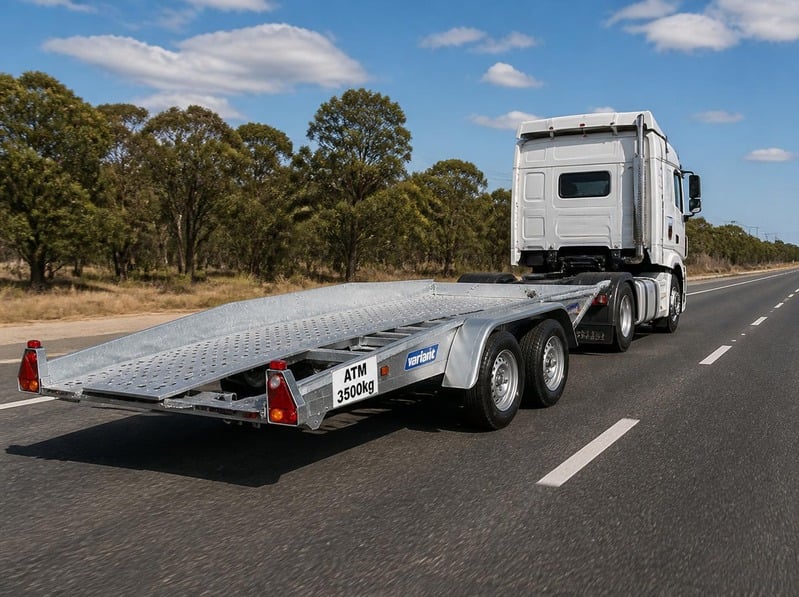
A trailer plated at 3,500kg, a strong truck and a 50mm ball on the back look like a safe match. They may not be.
The 50mm ball assumes a smaller truck
The Australian standard for 50mm ball couplings, AS 4177, assumes the towing vehicle has a gross vehicle mass (GVM) of 5,000kg or less. Within that, a compliant ball can tow a trailer up to 3,500kg ATM, provided every other limit is met. The figure that matters is the truck’s GVM, not its advertised towing capacity.
Above 5,000kg GVM the NHVR does not object to a 50mm ball, but the rating falls and must be calculated. The trailer’s coupling falls in the same way, so both ends need checking. NHVR Vehicle Standards Guide 16 gives these limits (kg):
| Towing vehicle GVM | 3,500kg ball / receiver | 2,000kg receiver | 750kg receiver |
|---|---|---|---|
| 5,000 | 3,500 | 2,000 | 750 |
| 5,500 | 3,241 | 1,928 | 750 |
| 6,000 | 3,089 | 1,873 | 745 |
| 6,500 | 2,972 | 1,829 | 738 |
| 7,000 | 2,878 | 1,793 | 732 |
| 7,500 | 2,801 | 1,763 | 727 |
These are limits for one component. They are not permission to tow at those masses.
The weakest part sets the limit
The lowest-rated component governs: ball, towbar, trailer coupling, drawbar and the combination mass limit. A stronger ball does not lift a weaker towbar. A lower limit for one truck and trailer pairing is a limit on that pairing. It is not a change to the trailer’s plated ATM.
European trailers: same 50mm ball, different paperwork
Couplings on European trailers, including Knott and AL-KO units, are commonly approved to UN/ECE Regulation 55. R55 lists the 50mm ball (Class A), the hook coupling (Class K) and the toroidal drawbar eye (Class L), and rates each by a D-value: the reference value for the horizontal forces between truck and trailer. Where a vertical load applies, the coupling also carries an S or V value.
What that means in practice:
- The ball size is the same. R55 Class A is a 50mm ball, the same size Australian rules name. A 40mm or 60mm “ball” is not part of either system, so check what the figure refers to.
- Read the marking. The D-value on the coupling is the number to check against the truck and trailer masses. The lowest-rated part still sets the limit.
- Replacing a coupling is a rating-and-approval job. Match or exceed the marked rating of the original, keep the braking arrangement, and confirm the approval and installation route for your state.
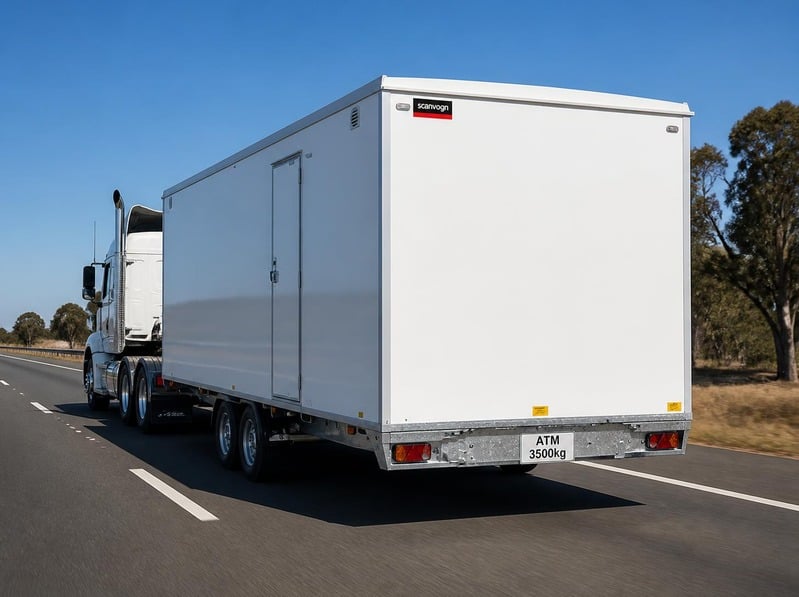
A pintle hook and drawbar eye is another route
The ball is not the only recognised coupling. Australian design rules also cover hook couplings, which include the pintle hook, together with the drawbar eye that goes with them.
The reduction that applies to the 50mm ball does not apply to a hook and eye. That does not give a hook and eye a rating of its own. Its limit comes from the ratings marked on the hook and eye, the drawbar, the towbar and the combination mass. Swapping the coupling does not change the trailer’s plated ATM. Whether the full 3,500kg is kept depends on matched, verified components, braking, mounting and approvals.
A short warning on ball sizes
For a trailer up to 3,500kg ATM, the standard ball is 50mm. Larger 70mm balls are also sold in Australia for heavier ratings, each with its own rating and approval evidence. A 40mm or 60mm ball is not part of either. Do not use one on an Australian road unless the whole coupling has approval evidence for the job.
Before you tow or fit
Read the plates on the truck and trailer. Compare the ratings of the ball, towbar, trailer coupling and drawbar. Confirm the braking arrangement is kept. On a heavy vehicle, fitting a coupling goes through the installation and certification process, and state or territory rules apply to registered vehicles. If a trailer comes with a ball coupling, ask the supplier whether a hook and eye can be fitted, and for the rating and approval of that installation.
Questions on European trailer couplings or replacement Knott and AL-KO parts: A2B Trailers (02) 4367 0026, or A2B Euro Parts (02) 8960 7770.
General information only. It is not approval of a particular truck and trailer combination.
Sources: NHVR Vehicle Standards Guide 16 (50mm ball couplings) and its FAQ; NHVR VSB6 Section P; ADR 62; UN/ECE Regulation 55. Figures checked 20 October 2026.


