To Grease or Not to Grease: Trailer Tow Balls
October 26, 2026
How much towball weight does a trailer really need? Not as much as most people think. The “10% towball weight” figure is a rule of thumb, not a law and not an engineering rule. This guide explains what the towball, towbar and coupling ratings actually mean, why a lower static ball load can make towing safer at 100 km/h, and what really controls trailer sway on Australian roads.
Is 10% towball weight the law in Australia?
No. The 10% towball weight figure is a rule of thumb. It dates from when caravans were lighter and tow cars were smaller, and it stuck. Some trailers sit near 5% of their loaded mass on the ball, and some sit above 10%.
What the law does set is the limit. The towing vehicle’s towing capacity, the towbar, the towball and the trailer coupling each carry a rating, and the lowest rating in the combination is the one that applies. The Queensland Government’s Safe Towing Guide sets out these ratings and does not give a minimum towball percentage. Couplings must also meet Australian Design Rule 62/02 – Mechanical Connections Between Vehicles.
For the weights behind these numbers (tare, ATM, GTM and payload), see the guide to tare, ATM and payload trailer weights, or check a load with the trailer load calculator.
Couplings are rated for force, not just weight
European trailer couplings and towbars are approved to UN Regulation 55. Their main rating is the D-value, in kilonewtons (kN). The National Heavy Vehicle Regulator’s 50mm ball coupling guide (VSG-16) describes the D-value as the maximum force that can safely be imposed on the coupling, and gives the example of a 50mm ball coupling on a 3500kg ATM trailer having a maximum D-value of 20kN.
The D-value is calculated from the masses of the towing vehicle (T) and the trailer (R), in tonnes:
D = 9.81 × (T × R) ÷ (T + R)
Example: a 2.5 tonne tow vehicle and a 2.0 tonne trailer gives 9.81 × (2.5 × 2.0) ÷ 4.5 = 10.9 kN. The coupling must be rated at or above that figure.
The static towball weight is a separate figure, the S-value: the vertical mass, in kilograms, the trailer puts on the coupling while parked on level ground. The bigger truck, lower tow ball rating guide explains why heavier tow vehicles can reduce what a 50mm ball can safely take.
A real example: Knott K20 coupling head
A 2,000 kg trailer fitted with a Knott K20 coupling head typically has a manufacturer’s maximum static nose load (S-value) of 100 kg. That is 5% of the trailer’s 2,000 kg rating, rather than the common 10% rule of thumb.
Rather than treating 10% as a fixed rule, follow the lowest rating across your towing vehicle, towbar, towball and coupling. A trailer is rarely designed for an artificially low static ball load. How weight is distributed on the trailer and where the axle sits are what actually determine the ball load and keep the trailer stable on the road.
Couplings also carry a D-value (in kilonewtons, kN). This is a dynamic force rating calculated from the masses of the tow vehicle and trailer, not a multiple of static ball weight. Road bumps, dips and braking create dynamic forces on top of the static weight, so adequate D-value capacity and staying within static limits gives your setup margin for real-world driving.
Key terms at a glance
- S-value (kg): maximum static vertical load allowed on the coupling when parked on level ground.
- D-value (kN): dynamic force rating calculated from the tow vehicle and trailer masses, to handle road forces.
- Weight and axle placement: determines real-world ball load and stability. Avoid loading heavy items at the rear, or letting nose weight drop so low that the coupling lifts.
Static towball weight vs the load at 100 km/h
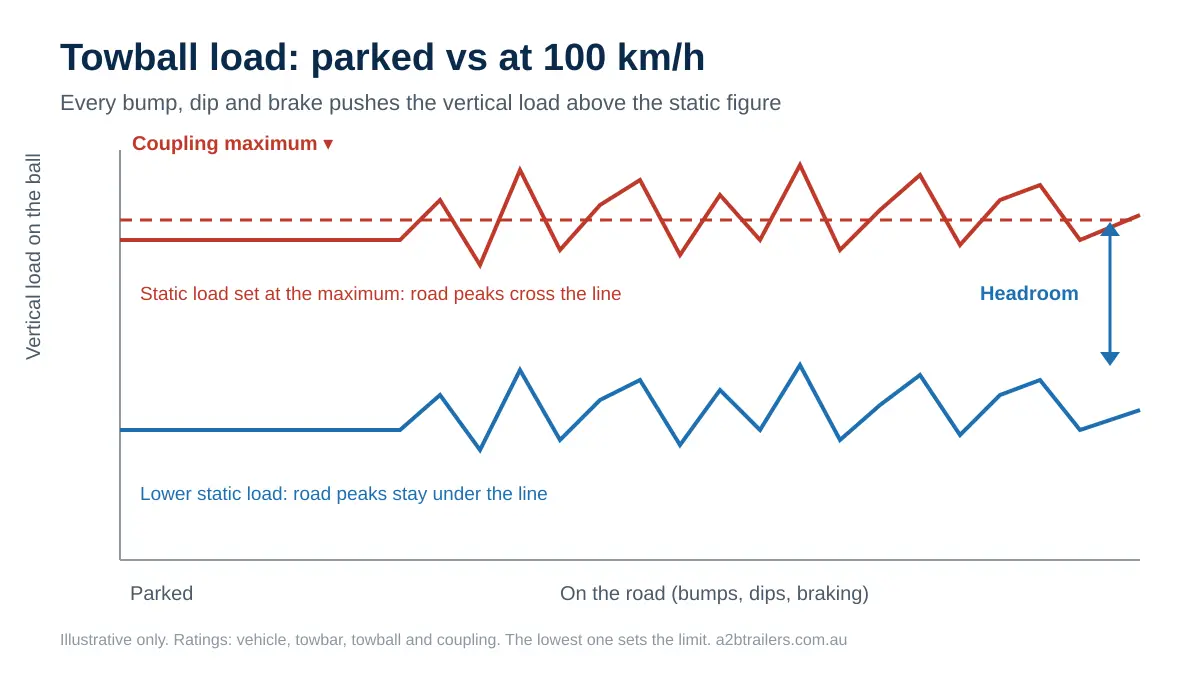
The figure on a towbar plate is what the ball carries standing still. On the road, every bump, dip and braking event pushes that vertical load above the static number.
A trailer that already sits at the maximum static towball weight has no margin left for those peaks. The peak loads go straight into the towbar, the coupling and the car’s rear axle. A lower static download leaves real headroom for the forces that actually occur at 100 km/h, the default open-road speed limit under the Australian Road Rules (Department of Infrastructure). Towing speed must also stay within the limit set by the trailer manufacturer and any posted sign.
Why the trailer sway video is often misread
The popular scale-model trailer sway video shows a trailer becoming unstable when the load is moved to the rear. What it demonstrates is rear-biased mass and high yaw inertia, with weight sitting behind the axle and at the far end of the trailer.
It does not show that adding towball weight makes a well-designed trailer more stable. In the rear-loaded case, the trailer is actually lifting on the ball. A correctly designed trailer, loaded to the manufacturer’s instructions, keeps a positive load on the ball so this cannot happen.
What actually causes and controls trailer sway
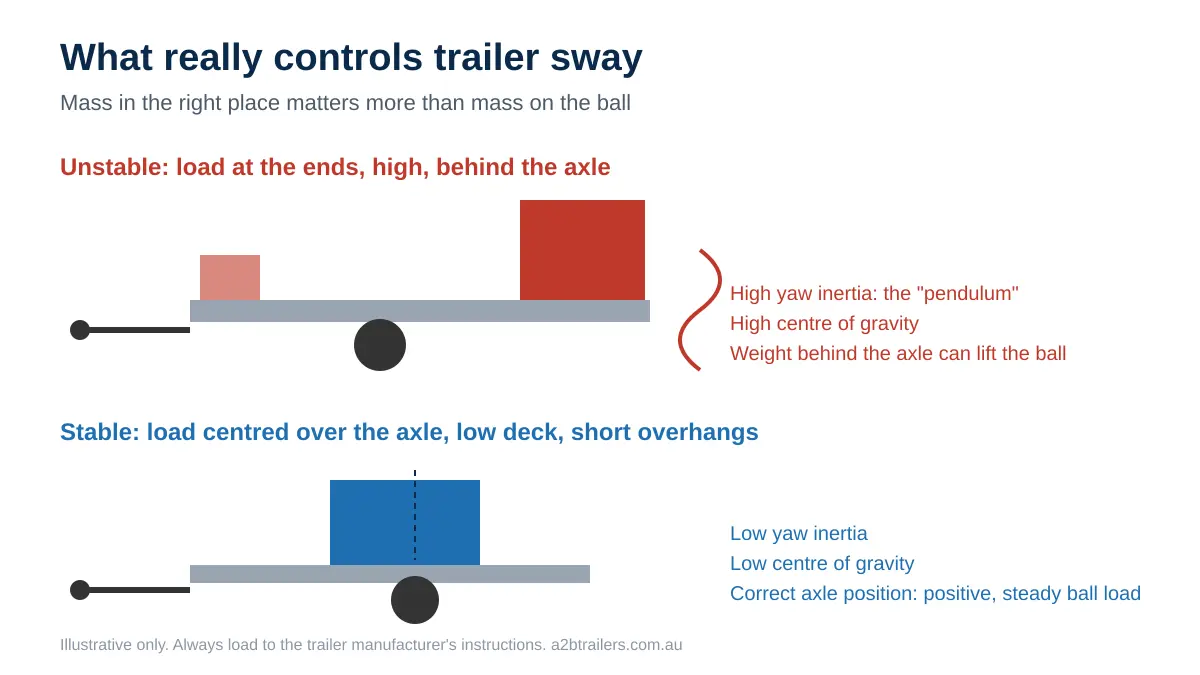
Cross-winds, passing trucks, uneven roads and sudden steering or braking can all start a trailer swaying. How quickly that movement dies away comes down to the trailer’s design. The main factors are yaw inertia, mass distribution (nose mass) and axle position. Variant European trailers are designed around all of them:
- Low yaw inertia: the load sits centred over the axle, with a light frame and short overhangs. Less mass at the ends means less “pendulum” for a gust or a passing truck to set swinging.
- Low centre of gravity: the deck sits low on a low-profile chassis, so the load rides closer to the road. That means less body roll and less sideways weight shift in crosswinds, lane changes and truck wash.
- Correct axle position: the trailer keeps a positive, stable load on the ball without overloading the car’s rear axle.
- European running gear: Knott torsion axles, with a stabiliser coupling where fitted, damp yaw movement before it builds.
If a trailer does start to sway, Queensland’s Safe Towing Guide advises against braking the towing vehicle. Hold a steady speed or accelerate slightly until the sway stops, or apply the trailer brakes gently if they can be operated on their own.
Why a lower static towball weight is better for your car
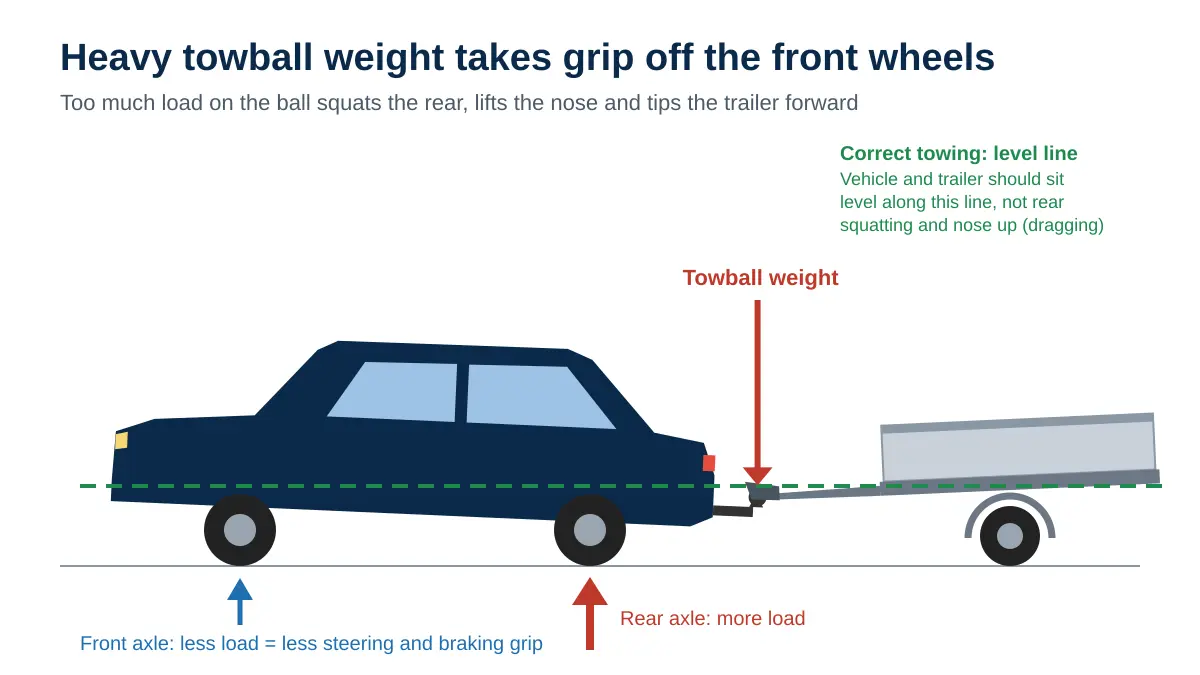
Extra towball weight loads the tow vehicle’s rear axle and lightens the front. That reduces steering and braking grip. If the vehicle is not designed for that load, it changes its steering, tyre loading and handling through bends.
A trailer that is stable through its design, rather than through heavy towball weight, keeps your car handling the way it was engineered to.
Long-term wear from heavy towball weight
A trailer that relies on heavy towball weight, towed with the car squatting and the trailer tipped forward, wears both vehicles faster over time.
On the tow vehicle:
- Rear suspension: springs and shock absorbers work harder on every trip and can sag over time.
- Tyres: rear tyres carry extra load and wear faster, while the lighter front tyres lose grip and can wear unevenly.
- Towbar and mounting points: repeated road peaks on top of a high static load cause fatigue in the towbar, its bolts and the chassis mounts.
- Rear wheel bearings and brakes: extra load on the rear axle adds wear.
On the trailer:
- Coupling, drawbar and A-frame: higher repeated loads at the front can lead to wear in the coupling and fatigue in the drawbar and its welds.
- Axles and tyres: on a tandem trailer, a nose-down stance shifts load to the front axle, so its tyres, bearings and brakes wear faster than the rear.
- Suspension: uneven load across the axles shortens suspension life.
A trailer that sits level with a correct, positive ball load spreads these loads as designed and lasts longer, along with the car towing it.
How to load a trailer for stable towing
- Check every rating: vehicle towing capacity, towbar, towball and coupling. The lowest one is the limit.
- Load to the trailer manufacturer’s instructions and stay within the coupling’s maximum static load.
- Keep heavy items low and centred over the axle. Avoid weight at the far rear.
- Never exceed the trailer’s ATM, tyre ratings or coupling capacity.
- Restrain the load so it cannot shift. See the trailer safety guide.
- Drive to the conditions and never above the posted speed limit or the trailer’s rated speed.

Towball weight FAQs
What is a good towball weight for a box trailer?
The right towball weight is the one the trailer manufacturer specifies, within the coupling’s maximum static load and your vehicle’s ratings. On many European trailers it is well under 10% of the loaded mass.
Is less than 10% towball weight dangerous?
Not on a trailer designed for it. Instability comes from weight behind the axle, high yaw inertia and a ball that lifts. A trailer with a positive, stable ball load and its mass centred over the axle is designed to tow steadily.
What is the D-value on a trailer coupling?
It is the coupling’s dynamic force rating in kilonewtons, worked out from the masses of the towing vehicle and the trailer. The coupling’s D-value must be at least the value calculated for the combination.
What is the S-value?
The S-value is the maximum static vertical load, in kilograms, allowed on the coupling with the trailer parked on level ground.
How fast can I tow a trailer in Australia?
Up to the posted speed limit, or 100 km/h on open roads with no sign under the Australian Road Rules. Some states and territories differ. Always stay within the trailer manufacturer’s rated speed.
European trailers built for stable towing
Browse the Variant European trailers range, including box trailers for sale, flatbed trailers, enclosed trailers and car trailers. Need Knott or AL-KO couplings, heads or parts? See parts for European trailers. Questions about towball weight for a specific trailer? Call A2B Trailers on (02) 4367 0026 or send an enquiry.