Why a Bigger Truck Can Mean Less Towing Capacity at the Coupling
October 20, 2026
To Grease or Not to Grease: Trailer Tow Balls
October 26, 2026


What do they mean and why do they matter?
If you are buying a new trailer there are a lot of technical details you need to consider. Trailer weights, particularly the tare, ATM and payload are the most important specifications to look at in a trailer. But what do these terms actually mean and why do they matter?
Tare weight
Tare weight is the weight of the trailer.
The lower the tare weight, the higher the payload capacity (relative to ATM) and fuel efficiency (if not max loading).
European trailers are made with high-quality, lightweight materials. Variant manufactures galvanised steel trailers for strength and durability, with lower tare weights than other steel made equivalents. Scanvogn’s mobile cabins are made with high quality UV-stabilised lightweight fibreglass panels. These panels are specifically designed lightweight to reduce the trailers weight while also providing insulation.
ATM
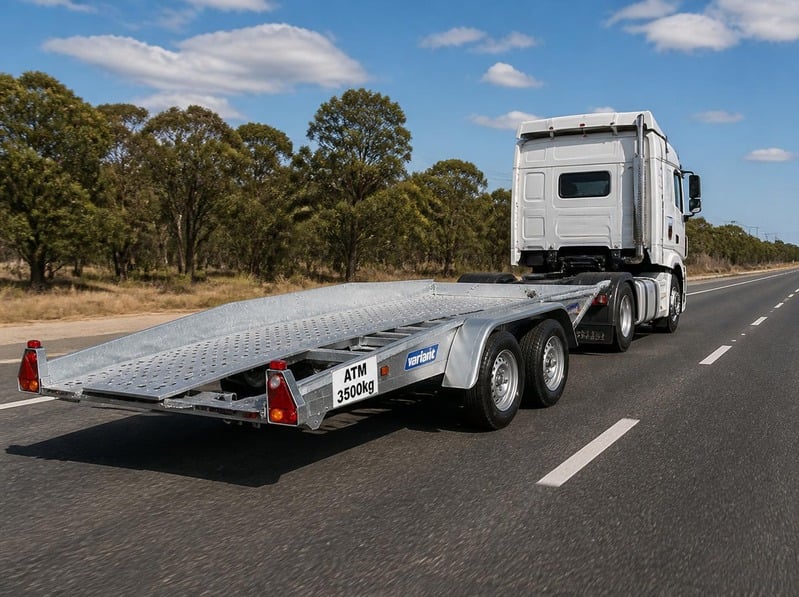
ATM stands for aggregate trailer mass and refers to the combined weight of the trailer (tare weight) and the maximum trailer load (payload).
The maximum trailer load has to be positioned correctly and safe, controlled. Positioning correctly will not significantly shorten the life of the vehicle’s body and mechanical components.
Look at the ATM/GTM to see if the trailer is suitable for your car to tow. For instance, if your car has a maximum towing capacity of 2000kg, it is advisable to be lower Atm/Gtm of the trailer or use reduced payload.
Do lot overload your vehicles towing capicity at any stage. Research the make and model of your car to ensure it can tow the trailer you want to purchase.
GTM
GTM stands for gross trailer mass. This is the weight of the trailer and its load when uncoupled from the vehicle.
In Australia and Europe, the ATM and the GTM can be the same number. 3500kg at GTM is not the weigth but a measurement of D-value.
Payload Capacity
Payload is the trailer’s carrying capacity, the difference between the tare weight and ATM.
Payload is important because the trailer needs to be able to support the load you want to carry.
Out of all specifications, trailer weights, tare weight, ATM and payload capacity are arguably the most important to consider when purchasing a trailer. You need to ensure that the trailer is light to tow, but can support the load to need to transport.
Trailer weight requirements
The requirements for tare, ATM and payload will vary depending on your needs. For instance, if you are purchasing a trailer for gardening or camping, you will need a small trailer that is easy to manoeuvre yourself, while still supporting a load. Whereas, a construction worker or handyman will need a heavy-duty trailer to transport heavy materials and machinery.
Tare, ATM and payload are the most important specifications to look at in a trailer, but you also need to know your vehicle’s specifications to ensure it can actually tow the trailer you want to purchase.
Check out this blog post to find out more about tare and payload, as well as other features to look for when buying a box trailer.
Trailers with low tare weight and high payload
Tare weight is what the empty trailer weighs, so a low tare leaves more of the ATM for payload. Variant and Scanvogn trailers are built light on galvanised chassis with mechanical overrun brakes. Browse by job:
- Tipper trailers for sale
- Flatbed trailers for sale
- Enclosed trailers for sale
- Plant trailers for sale
- Small box trailers for sale
- Fridge and freezer trailers for sale
Not sure which suits your tow vehicle? Use our Trailer Load Calculator, or contact A2B Trailers on (02) 4367 0026. Visit our showroom at 2 Aston Road, Erina NSW 2250.
How trailer weight affects your towing: your questions answered
Answers based on NSW Government towing guidance, checked November 2026. Rules vary between states, so confirm your own state’s requirements before you buy or tow. NSW towing rules.
Will my car or ute legally tow this trailer?
Check four limits, because your loaded trailer must stay under the lowest one: the towbar and coupling rating, your vehicle’s maximum towing capacity, the trailer’s maximum carrying capacity, and the tyres’ rated capacity. Your vehicle’s owner’s manual lists its towing limits. The trailer’s ATM is the ceiling for the trailer itself, so a 3,500 kg ATM trailer only suits a vehicle rated to tow the weight you will actually load on it.
How does ATM change what I can carry?
ATM minus tare is your payload, and everything on the trailer counts towards it: the load, straps, ramps, toolboxes and spare wheel. For example, the Variant X-Line Flatbed 3521 X5 has a 3,500 kg ATM and an 880 kg tare, which leaves 2,620 kg of payload. Pick the ATM from the heaviest load you will carry, not the average one.
Does a higher ATM make a trailer harder to tow?
Not by itself. You tow what is on the trailer, so a high-ATM trailer carrying a light load tows like a light trailer. What changes with a heavier loaded trailer is what the rules require: brakes, a breakaway system and safety chains (see the questions below). Low tare weight helps, because more of your towing capacity goes to the load you are paid to move.
Do I need brakes on my trailer?
In NSW it depends on the loaded trailer weight (GTM). Up to 750 kg no brakes are required. From 751 to 2,000 kg you need an efficient braking system on both wheels of at least one axle. From 2,001 to 4,500 kg you need brakes on all wheels. Trailers over 2.0 tonnes also need an automatic breakaway system, and the brakes must be operable from the driver’s seat. Rules in other states can differ, so check yours before you buy.
What if my vehicle’s manufacturer does not list a towing limit?
NSW sets a default. With working, connected trailer brakes the limit is one and a half times the unladen mass of your towing vehicle. If the trailer has no brakes, the limit is the unladen mass of your towing vehicle. If your manual does list a limit, that limit applies and must not be exceeded.
How many safety chains does my trailer need?
In NSW a trailer under 2,500 kg loaded needs at least one safety chain, and a trailer over 2,500 kg loaded needs two.
How do I match a trailer to my vehicle?
Work backwards in three steps. First, find your vehicle’s towing capacity in the owner’s manual. Second, add up the heaviest load you will carry and add it to the trailer’s tare. Third, choose a trailer whose loaded weight stays under every limit in the first question. If you tell the A2B team your vehicle and your load, we will point you to the right trailer. Call (02) 4367 0026 or ask for a quote.